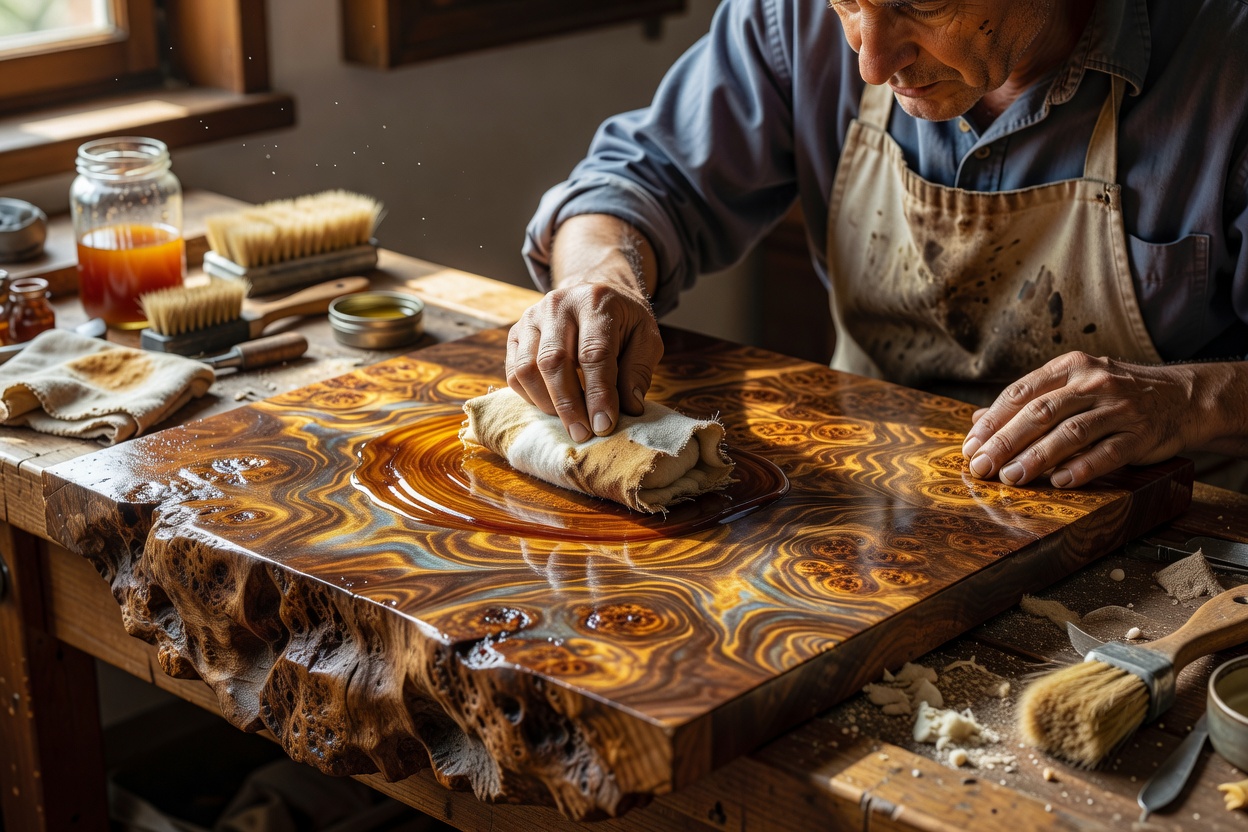
Primary European Cabinet Timbers
European cabinetmaking has evolved across centuries around specific regional timber species. Recognizing species variations is critical because each wood possesses unique shrinkage factors, cellular structures, and chemical reactivity to adhesives.
1. European Oak (Quercus robur & Quercus petraea)
From medieval monastic refectory tables to Flemish Renaissance cupboards, European oak provided the structural backbone of northern European carpentry. Oak features prominent medullary rays—ribbons of cellular tissue that reflect light like silver ribbons when the timber is quarter-sawn. Because oak contains high concentrations of natural tannic acid, it reacts intensely with iron, creating indelible dark blue-black stains if steel fasteners become damp. In restoration, we use unlacquered brass or wooden oak trenails instead of ferrous fasteners.
2. European Walnut (Juglans regia)
Prized in France, Italy, and Switzerland during the late 17th and 18th centuries, walnut offers a tight, satiny grain that carves with unmatched crispness. As walnut ages under indirect daylight, its chocolate tones gently mellow into warm golden honey. When restoring walnut, conservators must avoid aggressive modern chemical bleaching or synthetic walnut stains, which create a flat, purple-tinted hue completely at odds with historical aging.
3. Cuban and West Indian Mahogany (Swietenia mahagoni)
Introduced into European ports in the early 18th century, true Cuban mahogany is exceptionally dense, heavy, and naturally insect-resistant. When cut, it exhibits deep chatoyancy—an optical depth that looks almost three-dimensional beneath a French polish. Because ancient old-growth forests were depleted by the 19th century, conservation repairs must rely strictly on salvaged 18th-century timber fragments rather than modern plantation-grown Honduran mahogany, which is softer, lighter, and distinctly pinkish.
Veneers and Marquetry Arts
Historically, veneer was not a cheap substitute for solid wood; it was the ultimate demonstration of luxury and cabinetmaking skill. 18th-century veneers were sawn by hand with fine two-man saws, producing sheets between 1.5mm and 3mm thick. Modern commercial veneers, cut by industrial rotary knives, are paper-thin (0.4mm to 0.6mm).
In marquetry conservation, we encounter delicate combinations of fruitwoods (pear, cherry, apple), boxwood stringing, kingwood, tulipwood, and ebony. When heat or dry air causes marquetry pieces to pop loose, each piece must be numbered, cleaned of brittle animal glue on its underside, and re-secured into its exact matrix using warm bone glue under uniform pressure.
Traditional Surface Finishes Explained
Shellac & French Polish
Origin: Natural resin secreted by the Kerria lacca insect on trees in India and Southeast Asia, processed into flakes and dissolved in grain alcohol.
Behavior: Provides extraordinary optical clarity, enhances wood figure, and remains 100% reversible with alcohol. Vulnerable to heat and liquid alcohol.
Traditional Beeswax & Turpentine
Origin: Purified natural honeycomb wax blended with pure gum spirits of turpentine into an unctuous paste, often with carnauba added for hardness.
Behavior: Nourishes timber pores, breathes with ambient moisture, imparts a velvety tactile feel, and will never crack or flake like synthetic sealers.
Linseed & Walnut Oils
Origin: Cold-pressed flaxseed or walnut oils, traditionally heat-bodied with lead or manganese dryers in historical recipes.
Behavior: Penetrates deeply into timber fibers. Over decades it polymerizes into a durable water-resistant surface, though it darkens significantly with age.
Hardware: Gilt Bronze and Patinated Brass
The handles, escutcheons, and ormolu mounts of European furniture are works of sculpture in their own right. Genuine 18th-century bronze doré (fire-gilded bronze) features microscopic amalgam gold bonded to cast bronze through mercury vaporization.
Critical Conservation Rule: Never clean antique gilt bronze or ormolu mounts with commercial abrasive metal polishes (such as modern brass liquid creams). Abrasive polishes strip away the microns-thin historic mercury gilding, exposing the raw copper underneath and irreparably ruining the mount. Our workshop cleans hardware using ultrasonic distilled water baths and conservation detergent, leaving the patinated recesses intact to preserve sculptural depth.
Technical Workshop Note
"Patina" is not dirt. It is the microscopic compaction of wood fibers, hand-rubbed wax, atmospheric oxidation, and gentle handling across centuries. Removing patina to achieve a clean look destroys the authenticity that gives historic furniture its soul.